Pages

Showing posts with label Pop Culture. Show all posts

Tuesday, August 6, 2013

10 Years


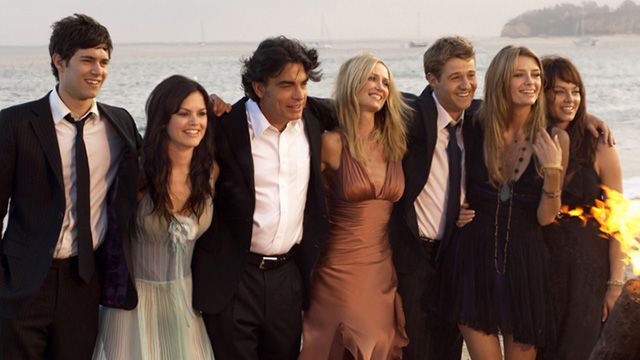
So yeah, when I title this 10 years, I'm talking about 10 years since the start of the television evening soap opera/drama/teen comedy thing called the O.C. which has been a consistent part of my television experience. Now I realize that this is not always the most morally sound show, that the characters make mistakes and the jokes are not always on color. With that acknowledgment, though, I'd be lying to you if I said that this was not my favorite television show of all time. In an effort to be honest, I will try and explain here why I love it so much. People will laugh at this, I'm sure, but I feel almost duty-bound to write it. And I promise there's a point. So here we go. 

One of my favorite websites out there is grantland.com. Once again, it's not Catholic or always perfectly on color, but I somehow find that the human commentary I find there on sports, pop culture, and everything in between is more authentic and real than what I find elsewhere, and so I love it. I digress. I am so very proud to be a fan of this website today, when there are 3 articles reflecting on the experience of the O.C. One article is by a person who never watched the show, but knows it changed the music world. Another is by a movie reviewer who does a wonderful job of explaining what the O.C. did so well. The third, the one I loved the most, is a personal reflection of the way that the O.C. impacted a man's life. Here's a quote:
"The O.C. was a show, and an experience, about growing up — especially behind the camera even as things were falling apart in front of it. Now that I write about TV full-time, I often think of that first set visit as a reminder that everything on the air is personal to somebody, even if the specific material isn't, and that much of what we fall in love with on TV is really just the hope and promise of beginnings. On soap operas, as in real life, the start of something is always brighter and better than the eventual slow fade of endings." 
-Andy Greenwald, Looking Back on The O.C., A Decade Later
Yes Andy, that's it. You see for me, the show didn't enter my life in 2003 when it started. When I was a junior in high school, though, looking at my time in high school starting to wind down and my future looming on the horizon in front of me, The O.C. came almost out of nowhere. Originally, I began watching this maybe as a joke or maybe to impress a girl or whatever (no comment), but quickly it became something more. Very quickly, my experience of this show was not some fictional soap opera about drama and relationships and the goings-on of rich kids  in California, but something much deeper.

Unlike Andy, I don't write about TV full-time, and I never got to visit the O.C. set like he did. I can, however, relate to the experience of saying that the things happening on TV are somehow personal to somebody, because that is my experience of this show. Was I going through the exact relationship issues of Seth and Summer? Had I gone through the change and turmoil or Ryan or of Marissa? Did I know what Sandy Cohen felt on a morning surf? No-of course not. I was a kid in the Chicago suburbs growing up. What I fell in love with, what I will still tell you about this show, is that through watching the material became personal because they experienced life at the same time I did. These characters grew up, and I grew up (or tried to). Every episode brought the hope of a new beginning. Every character went through rough times but kept moving forward. The prospect of life after high school was brighter than the end of the comfort of what I had known, and this show helped me to prepare for what was to come.

Listen, I'm not saying that I wanted to be like these characters. They were at times dysfunctional or worse, they made plenty of mistakes. And yet, in the midst of all of it, there was something I couldn't draw myself away from. From the raw experiencing of reality of Seth Cohen, making jokes always at the wrong time, to the turmoil of Ryan Atwood trying to figure out who the heck he is, something about these characters helped me learn who I was. And so, from those days until now, I watch this show and it makes me feel something. I'm not saying you need to run off and watch this show. But I am saying that, for me, there will never be anything that could compare.

You might think I'm crazy, but I think sometimes the Lord works in whatever way He knows He can reach us. For me, it was a crazy teen soap opera from the early 2000's (which spent the better part of every episode making fun of its genre in a way that you could miss if you weren't looking for it) which taught me that there is always a light, that the end isn't dark but that there is always a new beginning. And then, as quickly as it began, it ended. But it didn't end with the end. No, in the way that only this show was capable of, it ended by showing a whole bunch of new beginnings. Here's the final video. Don't make fun of me too badly, and don't forget that there is a brightness ahead that is much better than any darkness behind.


Tuesday, May 28, 2013

A Love which Knew no Bounds-the Story of Jay Gatsby

As you probably are tired of me saying, I am a die hard fan of the Great Gatsby. I wrote about the book here-now I want to comment on the movie because I'm obsessed. Since I'm in no way a movie critic, I won't even bother with the explanation of why I think Luhrmann actually did a good job for what he was attempting, but ultimately fell short of the brilliance of the book (impossible not to, in my opinion). Instead, I want to analyze the character Jay Gatsby, because, well, that's what it's all about.

Note: Spoiler Alert. There are many. If you haven't read the book and therefore are scared to go on, do yourself a favor and read the book. If you have, then it won't matter if I tell you about the movie because it is unbelievably faithful to the book's plot line. 

Jay Gatsby is the great anomaly of American literature in many ways. He is the bad guy, the sinner, the self-centered rich guy and simultaneously one of the most beloved men in literature, a sort of tragic figure who you can hardly help but root for. And so, when Leonardo DiCaprio was cast for this part, I remember thinking one thing: it couldn't be any other way.

No, seriously. Think about it; everyone knows of Leo, and everyone has an opinion. Most people dislike him for one reason or another, and yet it seems that in most of his movies you can't help but like him. You try and say that he's not a good actor, and then he pulls an Inception and you realize he's actually pretty darn good. Just like Gatsby, you want to have a horrible rumor about him be true (and I'm sure they're out there), but for the most part he's just a pretty loveable guy who isn't great but isn't quite bad enough at anything for you to hate him (my opinions on Leo may be debated, feel free).

And so, a little ways into this movie, we finally see the face of DiCaprio as Gatsby. What we see is the young, boyish face of a man who has enough money to own a mansion on the water and throw parties where the biggest gluttons in New York (and the whole country, for that matter) can come and leave satisfied (ish). Gatsby, though, isn't your average character; the entire story tries to show you who he is, and yet in the end you feel like you still might not have understood him at all, like you know no more than when you saw that smile, the kind of smile which you only see 4 or 5 times in a lifetime (Fitzgerald's words, I'm not that good).

I specifically want to point to one thing about Gatsby's character in the movie (and book, but movie shows it quite well) that I found most interesting: his complete and total dependence on the acceptance of others. Specifically, of course, this is based on the acceptance of Miss Daisy Buchanan, but it also carries over into his whole life and every relationship.

Gatsby is, it seems, living the American dream; he's the personification of the wild and "wonderful" life of the 1920s. He is rich, coming into his money by his own accord (albeit in some shadiness). He is a celebrity by all means of the word, with stories about his past being as broad and well-known as any character of the Jersey Shore today. He is good-looking, with girls from all over the city just trying to get a glimpse of him at a party (if only because he is so mysterious). His smile is perfect. His clothes are perfect. He throws wonderful parties (of particular interest to many people today). The list could go on and on.

Why, then, we might ask, would Gatsby still be desiring something? It seems that no matter what he has, he can't possibly risk not having the approval and acceptance of those around him. When people see his house, he wants it to be perfect. When people see him, he must be presentable. When, later in the movie, he loses his temper, he immediately apologizes, ashamed for being seen in such a light.

All of this, of course, is a ploy for one woman to see him, to notice him, to desire him, and most of all to love him. This, it seems, is the crux of Gatsby's character; he has everything, and yet his insecurities will not cease until he has the affection of the one woman who means so much to him, the one woman for whom he did all of this. Gatsby shows us something profound: wealth, success, connections, influence, possessions, reputation, etc. are all nothing in the grand scheme of things. Human beings were not made to be well-known, human beings were made to give and receive love.

For Gatsby, this was first with Dan Cody, the man who took him in and taught him how to be respectable and successful, but mostly taught him what it looked like to care for another person. After this, he met Daisy Buchanan, and she became all that mattered for the rest of his entire life (quite literally, as we know his life ended quite tragically and quite early).

At the end of the book, we understand his character in a way that the movie could have benefited from showing: Gatsby's dad (father of James Gatz, that is, Gatsby's real name) is one of the few that shows up for the funeral. What his dad has to say is profound; he shows Nick a journal entry of Gatsby from when he was young which detailed a daily schedule for him to improve himself. Gatsby, his dad explains, was driven from an early age to aspire to greatness, to step outside of the limits set for him, to better himself and to do something great with his life.

In the end, many would say that he failed; Jay Gatsby was killed, he was a criminal, and he was involved in adultery. While these things are never to be condoned, and in that sense he did fail, what is obvious to me is this: Jay Gatsby would not have said that he failed for any of those reasons, but simply because he did not end up with Daisy. While his quest for her was often misguided and inappropriate, Gatsby showed that he had found a simple truth in life: when you find love, you should do everything to cling to it. While my moral compass tells me that there are things which should stop you from seeking that thing you love, and I believe that is a truth which I should hold onto, there is something I admire greatly about Jay Gatsby and the way that nothing could possibly deter him from seeking his love, from finding her and being with her as he knew he was meant to be.

The sadness of Gatsby's story is that he didn't end up with his love, for she had moved on and chose not to think about him but live her new life (I do like that she stayed married to her husband, but find it sad that she married him when she loved another more). His story is sad because he died too early. His story is sad because the love disappeared in many ways when Daisy was brought into his life and she wasn't just the light in the distance any more. Jay Gatsby's story, in many ways, is nothing short of tragedy.

And yet, as I started with saying, I can't help but wish things had worked out for Gatsby. I wish Daisy had waited for him. I wish Tom would've been good for Daisy, maybe allowing Gatsby to be happy. I wish Wilson hadn't killed Gatsby. I wish that the story had a happy ending. And maybe there's something for me to learn from the fact that Gatsby's selfish, no-holds-barred pursuit of Daisy outside of any moral code didn't end well; in fact I'm sure there is. But there will always be a part of me that respects Gatsby; not for doing things that were wrong, but for knowing that he would never be complete without giving and receiving love, and for trying to seek that love.

So I rambled a little about Gatsby and didn't get anywhere except to see that I can't wrap my mind around this character. Maybe that's the point, or maybe I'm just too caught up in comparing the morals of the story with the heartfelt love of the story. Whatever the case, I know that I can't help but love the guy, and I know that I thoroughly enjoyed watching DiCaprio take a stab at presenting him to us (in 3-D for like $127 a ticket, because they can), even if there is no way he could've captured all that was meant by Jay Gatsby.
"The truth was that Jay Gatsby, of West Egg, Long Island, sprang from his Platonic conception of himself. He was a son of God—a phrase which, if it means anything, means just that—and he must be about His Father's business, the service of a vast, vulgar, and meretricious beauty. So he invented just the sort of Jay Gatsby that a seventeen year old boy would be likely to invent, and to this conception he was faithful to the end."
"Gatsby believed in the green light, the future that year by year recedes before us. It eluded us then, but that's no matter—tomorrow we will run faster, stretch out our arms farther. . . . So we beat on, boats against the current, borne back ceaselessly into the past."