Pages

Wednesday, August 14, 2013

[Coffee with the Saints]: St. Maximilian Kolbe


Today in the Church, we celebrate the feast one of the greatest saints and martyrs of the Church and specifically of the 20th Century. If you don't know the story and want to read more about it, you can follow this link for a great explanation of the life and story of this great saint! 

http://www.patheos.com/blogs/theanchoress/2013/08/14/maximilian-kolbe-catholic-subversive/

For me, Kolbe is an example of following the Lord daily and faithfully to prepare for the much difficult call he may place in our lives. While most of us will never be called to die in the way Kolbe died, we are called to live with the profound surrender that he showed in both life and death. If we are going to live in the great way God is calling us to, we must live for Him in every single moment, fighting for Truth and goodness and love to be what guides our thoughts, words and actions. May God bless each one of us today with the grace to live for Him in a radical way today and every single day. 

"Beyond armies of occupation and hetacombs of extermination camps, there are two irreconcilable enemies in the depths of every human soul: good and evil, sin and love. And what use are the victories on the battlefield if we ourselves are defeated in our innermost personal selves." -St. Maximilian Kolbe

ST MAXIMILIAN KOLBE...PRAY FOR US!!

This coffee with the saints is a series that I am doing to reflect on the lives of the saints; if you want to read more about it or see other saint posts, you can click the tab on the top of this page or click this link Saints

Tuesday, August 6, 2013

10 Years


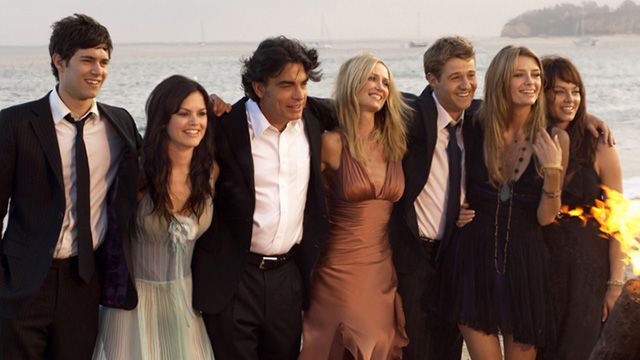
So yeah, when I title this 10 years, I'm talking about 10 years since the start of the television evening soap opera/drama/teen comedy thing called the O.C. which has been a consistent part of my television experience. Now I realize that this is not always the most morally sound show, that the characters make mistakes and the jokes are not always on color. With that acknowledgment, though, I'd be lying to you if I said that this was not my favorite television show of all time. In an effort to be honest, I will try and explain here why I love it so much. People will laugh at this, I'm sure, but I feel almost duty-bound to write it. And I promise there's a point. So here we go. 

One of my favorite websites out there is grantland.com. Once again, it's not Catholic or always perfectly on color, but I somehow find that the human commentary I find there on sports, pop culture, and everything in between is more authentic and real than what I find elsewhere, and so I love it. I digress. I am so very proud to be a fan of this website today, when there are 3 articles reflecting on the experience of the O.C. One article is by a person who never watched the show, but knows it changed the music world. Another is by a movie reviewer who does a wonderful job of explaining what the O.C. did so well. The third, the one I loved the most, is a personal reflection of the way that the O.C. impacted a man's life. Here's a quote:
"The O.C. was a show, and an experience, about growing up — especially behind the camera even as things were falling apart in front of it. Now that I write about TV full-time, I often think of that first set visit as a reminder that everything on the air is personal to somebody, even if the specific material isn't, and that much of what we fall in love with on TV is really just the hope and promise of beginnings. On soap operas, as in real life, the start of something is always brighter and better than the eventual slow fade of endings." 
-Andy Greenwald, Looking Back on The O.C., A Decade Later
Yes Andy, that's it. You see for me, the show didn't enter my life in 2003 when it started. When I was a junior in high school, though, looking at my time in high school starting to wind down and my future looming on the horizon in front of me, The O.C. came almost out of nowhere. Originally, I began watching this maybe as a joke or maybe to impress a girl or whatever (no comment), but quickly it became something more. Very quickly, my experience of this show was not some fictional soap opera about drama and relationships and the goings-on of rich kids  in California, but something much deeper.

Unlike Andy, I don't write about TV full-time, and I never got to visit the O.C. set like he did. I can, however, relate to the experience of saying that the things happening on TV are somehow personal to somebody, because that is my experience of this show. Was I going through the exact relationship issues of Seth and Summer? Had I gone through the change and turmoil or Ryan or of Marissa? Did I know what Sandy Cohen felt on a morning surf? No-of course not. I was a kid in the Chicago suburbs growing up. What I fell in love with, what I will still tell you about this show, is that through watching the material became personal because they experienced life at the same time I did. These characters grew up, and I grew up (or tried to). Every episode brought the hope of a new beginning. Every character went through rough times but kept moving forward. The prospect of life after high school was brighter than the end of the comfort of what I had known, and this show helped me to prepare for what was to come.

Listen, I'm not saying that I wanted to be like these characters. They were at times dysfunctional or worse, they made plenty of mistakes. And yet, in the midst of all of it, there was something I couldn't draw myself away from. From the raw experiencing of reality of Seth Cohen, making jokes always at the wrong time, to the turmoil of Ryan Atwood trying to figure out who the heck he is, something about these characters helped me learn who I was. And so, from those days until now, I watch this show and it makes me feel something. I'm not saying you need to run off and watch this show. But I am saying that, for me, there will never be anything that could compare.

You might think I'm crazy, but I think sometimes the Lord works in whatever way He knows He can reach us. For me, it was a crazy teen soap opera from the early 2000's (which spent the better part of every episode making fun of its genre in a way that you could miss if you weren't looking for it) which taught me that there is always a light, that the end isn't dark but that there is always a new beginning. And then, as quickly as it began, it ended. But it didn't end with the end. No, in the way that only this show was capable of, it ended by showing a whole bunch of new beginnings. Here's the final video. Don't make fun of me too badly, and don't forget that there is a brightness ahead that is much better than any darkness behind.


Sunday, August 4, 2013

[Book Review]: The Word in Scripture and the Word in Flesh

This book review is on one of Dr. Scott Hahn's newest books, Consuming the Word. You find Dr. Hahn's personal website at www.scotthahn.com, where you can see a list of all of his works, as well as learn more about his work, his ministry, his wife, and having him come to speak at your Parish or event. You can also find the direct link to purchase this book on Amazon through this link: Consuming the Word, and you can learn more about the book on his website or through this link Image Books: Consuming the Word


Consuming the Word:
The New Testament and the Eucharist in the Early Church

Dr. Scott Hahn
Image Books, 2013

If you don't know anything about Dr. Hahn, you are in for a treat with this book; if you've read everything he's ever written, you are once again in for a treat with this book! Dr. Scott Hahn is a professor at Franciscan University of Steubenville, Ohio, where he is the Fr. Michael Scanlan Chair of Biblical Theology and the New Evangelization, as well as being the founder and president of the St. Paul Center for Biblical Studies.

All of that aside, though, let's get on to this book, where you can see a great example of what made Dr. Hahn so popular. In this book, Dr. Hahn continues his look at the Eucharist in Scripture and what it is that made the Eucharist the center of the Catholic faith. Specifically, this book looks at the New Testament and the Eucharist in the early Church, and the way that they took their form. In the way that Dr. Hahn is so skilled at doing, he takes this incredibly difficult and dense topic and presents it in a way that scholars will benefit from; even more impressive, though, is that he presents it in a way that the ordinary and more or less uninformed Catholic can also benefit from. This book goes through the New Testament texts and the writings of the early Church fathers, explaining how the Eucharist became, or, as he explains, always was, the central part of the Christian life. 

One of the most beautiful things that Dr. Hahn does throughout this book is to talk about the way that the New Testament (as we know it) took the name Testament. This word, he explains, comes from the word covenant, meaning an extension of kinship. or bringing a person into one's family through a relationship. What does this mean? What Dr. Hahn shows throughout a large portion of this book is that what that means is that the idea of the New Testament was to show the covenant which Jesus Christ had established with His Church in the Eucharist. For the Early Church, he shows, it wasn't about a group of texts which were known as the "New Testament," but rather it was about the Sacrament of the Eucharist, where these texts would be proclaimed to the people. The texts we know as the New Testament weren't a Testament to them; they were a Person, the Word, the person of Jesus who lived on through the writings of His followers. Testament, the word we use, came to be through the idea of this being a covenant, a relationship of the Word of God, the person of Christ, with His people. 

The other main point which stuck out to me in Dr. Hahn's book was the very idea of the Word of God made flesh, Jesus Christ, and the way that we encounter Him in the Church today. In a beautiful way, Dr. Hahn spends a portion of this book explaining that for the early Church, and still for the Church today, the Mass is the place where the faithful receive the Word through Scripture and through Sacrament. What this amounts to, he explains, is to lead us to the full communion between God and man, the "marriage supper of the Lamb" (Revelation 19:9), where "the human family is 'divinized,' made to dwell with God, made full participants in the life of the Trinity." The Mass, Dr. Hahn shows us, is the place where this is lived out on earth, where we are brought into communion with the Father through His Son, the Word, whom we receive at each and every Mass. 

If you are Catholic, Christian, or otherwise interested in the Eucharist and the way that it plays into the life of the Catholic Church, this is the book for you. At 146 pages it took me only 2 days to read this book, so if you don't have a lot of time it is perfect for you. If you are more theologically minded, parts of this book will be a review, but there will certainly be parts of this book which are new will help you in your journey of faith. If you are not theologically minded, this book, along with most of the corpus of Dr. Hahn's work, is a perfect way to bring you into deeper relationship with Christ through the renewal of your mind (Romans 12:2). 

To close, I want to finish with the quote that Dr. Hahn finishes his book with, speaking of the way that we receive the Word made flesh, the promise of the Old Testament, explained in the New Testament, and alive in the Church today. May God bless any of you who read this! 
"We live the dream of the prophets and the seers, we live the promise of the divine covenant, we are given the bread of angels, whenever we consume the Word." 


"I received this book for free from WaterBrook Multnomah Publishing Group for this review as a part of their blogging for books program; you can learn more about this by visiting the program's website here Blogging for Books."  

Saturday, August 3, 2013

The Everlasting Man

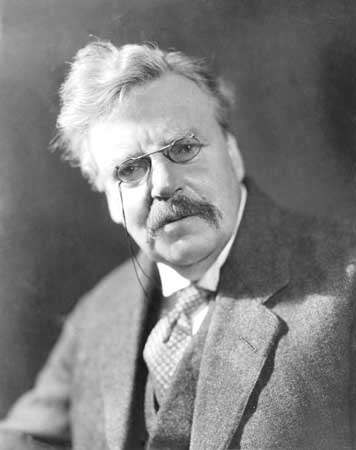
For any of you that have ever read anything by this man to the left, you know that it is a wonderful (as well as, at times, challenging) experience. The man, for those of you who don't know, is G.K. Chesterton, one of the very greatest authors in the 20th Century, if not in all of history. The book which I want to comment on a bit here today, called The Everlasting Man, is one of his most influential works. Many (if not all) of you will have heard of C.S. Lewis (Chronicles of Narnia, Screwtape Letters, Mere Christianity, etc.)--what you may not know is that Lewis largely attributes his conversion process to this book from Chesterton. Knowing that, I knew that this book would be something special-and probably especially difficult. While it was, at times, difficult to process, it was worth every second of the struggle.

I will not try to give an overview of this entire book, because Chesterton himself took ten very dense pages to summarize the book in conclusion, and I won't pretend to have the ability that he himself had. Rather, I want to give an explanation of the overall point he tries to make briefly, and then spend the majority of this post commenting on one particular idea he presented.

The Point


As Chesterton himself explains in the book, The Everlasting Man is primarily a historical look at man. Chesterton, a Catholic, says that this is not about defending Catholicism against Protestantism, but against the various Pagan religions which can tend to be the light through which we view history. Rather than seeing Christianity as the next step in the development of man, as some people in his time wanted to say, Chesterton spends this volume of work explaining that Christianity, and specifically the person of Christ, are unique and new. The first half of the book is on "The Creature Called Man," and the second half is on "The Man Called Christ." I cannot summarize this book in any way better than this, and so I present what Chesterton himself says is the goal: the book's "thesis is that those who say Christ stands side by side with similar myths, and his religion side by side with similar religions, are only repeating a very stale formula contradicted by a very striking fact." The book, then, takes this as its basis; weaving through the process of the development of the various myths, stories, and religions of world history, Chesterton shows the way that Christianity cannot simply be another myth. I will not attempt to sketch his argument; for that, you must dive into this book headfirst, allowing yourself plenty of time to think through the points he makes. I will, though, assure you that it is worth the effort. 

The Uniqueness of Christ


Here, from the third chapter of the second part of The Everlasting Man, is a passage which lays out a point I would like to reflect on a bit: 
For in that second cavern [the tomb of Christ] the whole of that great and glorious humanity which we call antiquity was gathered up and covered over; and in that place it was buried. It was the end of a very great thing called human history; the history that was merely human. The mythologies and philosophies were buried there, the gods and the heroes and the sages. In the great Roman phase, they had lived. But as they could only live, so they could only die; and they were dead. 
On the third day, the friends of Christ coming at daybreak to the place found the grave empty and the stone rolled away. In varying ways they realised the new wonder; but even they hardly realised that the world had died in the night. What they were looking at was the first day of a new creation, with a new heaven and a new earth; and in a semblance of the gardener God walked again in the garden, in the cool not of the evening but of the dawn.
Go ahead and read that 2, 3, 17, 12938 times if you'd like; it's still going to be beautiful. What Chesterton is getting at in this point of the book is something so incredible that even this beautiful prose can't possible capture it. The person of Christ is not simply another god in another myth or religion. He is, in so many varied ways, totally new and unique. The uniqueness of this person is captured in the boldness of the claim He made: He was a man who was killed, and yet rose again from the dead because He was not just a man, but He was also God. And when the God-man died, He died not to stay dead, but to bring about a new creation. This new creation is lived out here and now in the Church of Christ which has endured 2,000 years and is still here today.

One of the most beautiful parts of what Chesterton shows of this is his reflection on the endurance of the Church, but I will let you read the book for that. For now, I will leave it with that passage above, reflecting on the fact that God, who created everything, came as man into that creation, ushering in a new creation by His death and Resurrection so that we didn't have to live in brokenness but could have new life.

In modern times, the arguments of this book will be even more offensive than they were 100 years ago. In a day and age when the popular view of world religions is a bunch of different ways to be a 'good' person, Chesterton's assertion that Jesus Christ and the religion which bears His name are utterly unique would offend many people, and yet that seems to be the point. Chesterton is not trying to offend, and yet the boldness of the claim, a claim for which countless men and women have died and are still dying every day, is by its very nature offensive. Christ came and ushered in a new creation, offending our human sensibilities because no one but Him would dare claim that God became man. No other religion has nor will claum this, because it is such a bold claim that it is nothing short of ridiculous and offensive if it is not true. And yet, Christianity has endured 2,000 on a Truth which is so crazy that it can only be true to have survived.

With Chesterton, then, we can have confidence in this Church by the virtue of its ability to withstand all manner of trial and difficulty for these years. We can stand in confidence on the Church which Christ established that lives on in the world today.
"Had Christianity merely appeared and disappeared, it might possibly have been remembered or explained as the last leap of the rage of illusion, the ultimate myth of the ultimate moo, in which the mind struck the sky and broke. But the mind did not break. It is the one mind that remains unbroken in the break-up of the world." 
If you are looking to pick up a copy of The Everlasting Man, here is a link to get it on Amazon! The Everlasting Man


You can see other book reviews that I have done by going to this link: My Library . 

Friday, August 2, 2013

Dive In; Where My Feet Are

Note: I realize I haven't written on here in a while-for that I apologize. I have been doing some writing this summer over here at lighthouse catholic youth, and I love the project we've been working on. Check out the lighthouse blog: click here. This post is my most recent one there, released today. 

For the next two weeks, these are the events that I have planned: a barbecue, a bonfire, a game night, a trip to an amusement park, a Bible study, a softball tournament, a birthday party, another Bible study (I am a youth minister), a Pittsburgh Pirates’ game, another game night (like I said, I am a youth minister), an 8-hour drive, a round of golf, and a cross-country flight. Maybe your schedule in the summer looks like that: endless events, all of them fun, one after another. Maybe, like a friend I talked to recently, your summer looks a heck of a lot more open than that. Whatever our situation, one of the most difficult things for us modern day people seems to be pausing to be present wherever we are.  

The other day, for the first time in what seems like months, I had a day with literally no obligations....

Read the rest of this post on being present where we are by following this link: Where My Feet Are.