Pages

Wednesday, March 13, 2013

Habemus Papam!


I left a meeting today, fully aware that I was going to still be in the car when we saw smoke. I assumed it'd be black, and so I took the time to go to Dunkin Donuts because I wouldn't make it back anyway.

But, just in case, I streamed EWTN on my phone to listen and wait. Then, a few minutes after 2, I heard them say smoke. I was at a stoplight (I promise) and so I watched the smoke. They said it was black, I could see it was white. I started driving, and they figured it out.

I yelled, I freaked out. I cried. I yelled some more. I didn't know what to do.

When I got back to work, I watched with the little kids from the school who I watch once a week after school as they brought him out, they announced a new Pope. I didn't know him, but then we saw him for the first time, and we listened.

Needless to say, I was blown away. A few things stuck out to me today:

This man is amazingly humble.

The time for a massive crowd in Rome to silently pray for our new shepherd was one of the most profound things I've ever experienced.

The Church is alive, She is doing just fine.

I've never been happier to be Catholic.


Pope Francis. It couldn't be more perfect. A humble leader called to rebuild the Church. We have him. We trust in his guidance, and the wisdom of the Spirit.

The Church lives on with the grace and strength of our Lord. We push forward to evangelize the whole Lord through our new humble leader. The world thought we'd pick a strong CEO. Instead we picked a humble man who loves the Lord so deeply that you can't not notice it.

I can't wait to let this man lead our Church through the Holy Spirit. Praise God.

AMDG

Tuesday, March 12, 2013

A Beauty Ever Ancient, Ever New

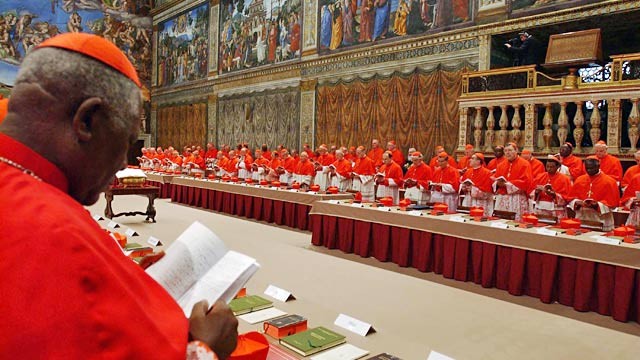
Sitting today and watching the Cardinals process from the Pauline Chapel to the Sistine, listening to them sing the Litany of the Saints, hearing the Veni, Sancte Spiritus, listening to the Cardinals take the oath together and then watching them do it individually, finally seeing the doors closed as they begin this holy and astonishingly important process today was all so surreal. It was moving. Most of all, I think, it was a powerful image of exactly what it is we say we believe when we profess faith in the creed.

This ceremony, so ancient and yet ever-new, like our faith, is not done because the Church is stuck somewhere in the past, but it is done because She is guiding us forward with the steady hand of truth and love. Our creed professes a faith laid out in the 4th Century which did not stay there but has lived on and guided the Church and Her people ever since, and will continue to until the end of time.

When the Cardinals say these timeless prayers, when the door to the Sistine Chapel is locked from the media, it is not because they can't figure out how to integrate into 2013, but because the Church and Her leaders know that what is happening here is not simply an election in 2013 but a timeless action of God's Bride on Earth, the Church.

And so we wait. We are not scared, we are not worried. We don't doubt the presence of the Holy Spirit or the wisdom of the Cardinals. We know they are men, but that they are guided by the One who leads and guards the Church every day. Knowing this, we are assured that when we see white smoke and hear those amazing words "Habemus Papam" we will move forward in the Grace of God and the Church will continue to live and thrive under the leadership of the new "Servant of the Servants of God."

Until then, we simply pray, trusting in God's providence and His care. Here is the prayer they prayed today, let us pray with them.


Deus, qui, pastor aeternus,
gregem tuum assidua custodia  gubernas,
eum immense tua pietate concedes Ecclesiae pastorem,
qui tibi sanctitate placeat,
et vigili nobis
sollicitudine prosit.
Per Dominum nostrum Iesum Christum Filium tuum,
Qui tecum vivit et regnat in unitate Spiritus Sancti, Deus, per omnia saecula saeculorum.Amen
O God, eternal shepherd,
Who govern your flock with unfailing care,
Grant in your boundless fatherly love a pastor for your Church
who will please you by his holiness and to us show watchful care.
Through our Lord Jesus Christ,
your Son,
who lives and reigns with you in the unity of the Holy Spirit, one God, forever and  ever.Amen.

Monday, March 4, 2013

The Need for Separation

I've written this post twice now and edited it a bunch of times to try and make it sound right. I'm not sure I can get my thoughts out correctly, but I will do my best-feel free to critique or disagree.

This explosion of thoughts from my mind is probably a long time coming, as I have often thought about the need for a discussion of an idea which seems so popular in modern times that it has become an ideal in many different circles, for Christians as well as many others, sometimes explicitly and other times implicitly.

I most recently encountered this idea when I came across a video of Richard Rohr, a Franciscan friar and priest for whom I have much respect, but whose idea about the way that we experience the Holy Spirit made me pause. When he explained the Spirit he called Him a consciousness, a consciousness which is inside of man, and everyone simply plugs into and experiences, making that person more of who they are meant to be by going deeper into their own consciousness.

Now, I need to specify that I am not writing this to dispute particularly his point, because, as I said, he is a holy and intelligent man who probably has a lot more to say on this than the point which bothered me, but I think that these words of his made me think about something that has often bothered me.


The idea I want to discuss here which bothered me is this: we are more alike than we are different; or to put it in the now infamous words of the wildly popular High School Musical song "we're all in this together."
I am not trying to say we're not, because Christ clearly wanted us to work together, to support one another, to build each other up (read any of the letters of the New Testament for evidence of all of this) and to reach our salvation with the aid of others. It seems to me, however, that this idea has been taken too far, and now we don't just look to help each other, but we want people to believe that they ARE each other, that we're all to some extent the same. Therefore, helping the poor is not just a charitable act but a necessary one, because you aren't different from the poor and therefore have a certain need to help them.

When this becomes a problem, for me, is when the Holy Spirit is just something inside of ourselves that we all tap into the same way; when the people around the world are essentially just us in a different package; when there is nothing to separate one from another. While this grows out of a truly sincere desire to unite and encourage aid and help for others as well as encouraging an experience of becoming who you were made to be, what I have seen is that in uniting it removes the very reason to help, the very reason to love. The problem I see boils down to this fact: I can't (and definitely shouldn't) love myself in the same way I love another; even if I could, I wouldn't want to. In order to avoid this, I think we should be weary of anything which equates all people to the same, or even to reaching into some communal consciousness.

Our love for the poor, for the suffering, for those most in need of love ought not come from our sameness to them. If our love comes from this, the problem I believe we will see is that we will help not because we care about others, but because we care about us in them. If loving others is simply an act of loving ourselves, we are not loving.

When love is sincere, it seems to me, is only when love is a genuine love for another. In that, it becomes most important not to emphasize our sameness, but to emphasize our difference, showing that we are radically different, and this is what makes us each beautiful, unique, and deserving of love.

Christianity, then, is quite important in this sense, because it always has emphasized the unique and unrepeatable dignity of each and every single human being from conception to death and on for eternity. The dignity of the person can't be emphasized more; once you are created, you are you-uniquely and extraordinarily-for the rest of eternity.

The importance of what Christianity says is precisely this uniqueness-saying we're the same might want us to help ourselves, but takes away the freedom to love. Saying we're different, however, frees us to love. As Chesterton put it, Christianity is the sword which comes in and separates, not to isolate, but rather to free us to love.

And so, my argument is this-we are made to be separate and unique. We're made to be ourselves. And in being uniquely us, we are free to love in a radical and true way. The Holy Spirit is alive, and is in each of us. He is not in us, however, in the way that He is the same thing and we just tap into it deep down in our own consciousness, but in the way that He uniquely gives each of us what we need to become more truly ourselves, and in being ourself the Spirit frees us to love with a radical and not self-seeking love.

Let the Spirit be the sword that separates and, I believe, we will see that we care more about others than ever before.

Wednesday, February 27, 2013

The Last Audience


Today, Pope Benedict XVI gave his last audience has our leader, our father, and our Pope. I expected him to be less introspective, as he often pointed more to theology and teaching than to his own thoughts, but in the way we all hoped he took this time to reflect on his life and papacy. It was all brilliant, but one major point stuck out to me:

The “always” is also a “forever” - there is no returning to private life. My decision to forgo the exercise of active ministry, does not revoke this. I do not return to private life, to a life of travel, meetings, receptions, conferences and so on. I do not abandon the cross, but remain in a new way near to the Crucified Lord. I no longer wield the power of the office for the government of the Church, but in the service of prayer I remain, so to speak, within St. Peter’s bounds. St. Benedict, whose name I bear as Pope, shall be a great example in this for me. He showed us the way to a life which, active or passive, belongs wholly to the work of God.

Pope Benedict is very clear here: he is not leaving to sip beers on a sunny beach. He is not leaving to play with his cats. He is not leaving to flee the difficulties of his office.

He is leaving to run to the cross with everything he has. He is leaving to intercede for the Church, knowing that while his public leadership ends, his spiritual leadership continues, and he will continue to hold up the Church in prayer and sacrifice.

And so, Pope Benedict XVI, we thank you. You led us with humility and wisdom, and even today you lead us even more, showing us the importance of staying close to the Crucified Lord in good times and in bad, and teaching us, as you said in your conclusion today, to "let there be always the joyous certainty that the Lord is near, that He does not abandon us, that He is near to us and that He surrounds us with His love."


You can read his audience here: Final Audience English Text. If you haven't, I recommend you do. 

Thursday, February 21, 2013

Is God resting?


In Lent (well I guess all the time) it can become easy for life to seem dreary and the work of God in our lives to seem more or less absent. Lent amplifies this because it is usually a dreary time of year as far as the weather (ignore this if you live somewhere that's always warm) and we are fasting/sacrificing which makes every day harder.

In this state of mind/being it is easy for us to fall into the oh-so-common thought that God sets things into motion and then just lets them happen. Even when we get caught by beauty in the world today we are tempted, usually subconsciously, to remark at how amazing it is to see the flowers begin to sprout as the weather becomes warm without noticing Him who makes them sprout.

During these days it often becomes difficult for us to get quite as excited that the sun rises and sets, that the moon is quite beautiful when we can see it clearly, or that the snow falling can look quite beautiful if we stop to look at it. Instead, if we were to think about it for a second, we would most likely simply conclude that the sun rises simply because that's what the sun does, and that the snow falls because of the weather patterns making it so.

Wherein Chesterton Disagrees 


G.K. Chesterton saw this attitude that said things are the same because they have to be and vehemently disagreed. Chesterton compared the sun rising and setting to the attitude of a small child; when you do something the child likes, you must do it again and again until you become tired. The adult, inevitably, is tired of the thing much before the child is, and so we as adults assume the same about God-He couldn't possibly make the sun rise every day, for that would be quite boring. 

But, Chesterton asserts, why can't we simply believe that God doesn't get bored? Why can't we believe that He is active in our lives consistently and totally without fail each every day. Listen to Chesterton: 
For grown up people are not strong enough to exult in monotony. But perhaps God is strong enough to exult in monotony. It is possible that God says every morning, "Do it again" to the sun; and every evening, "Do it again" to the moon. It may not be automatic necessity that makes all daisies alike; it may be that God makes every daisy separately, but has never got tired of making them...The repetition in nature may not be a mere recurrence; it may be a theatrical encore. --G.K. Chesterton, Orthodoxy, p.51
For many of us, things seem to happen around us just because they do. People see something happen and chalk it up to chance or fate and move on. Maybe it is time, however, as Chesterton suggests, to see it as not necessary, but as God working to show us beauty, to move us forward, to bring us to Him.

Lent


And so this returns us to where we are now-Lent; this time of sacrifice, penance, and giving of ourselves when we often find ourselves a little slower to love and quicker to judge.

Maybe this Lent it would help to stop and to appreciate the world around us. Even in its gloom, its darkness, its brokenness, its despair-see how beautiful everything is. See how beautiful everyone is. Appreciate the things and people around you, and realize, with Chesterton, that we're not just here by chance, but rather that God has placed us here. Realize that He wants you to be alive, and now He has you in Lent not because He wants you to be bored with the same routine, but because He wants you to come alive and see His constant love for you. 

This Lent, stop for a second or two and see how He is profoundly active in your life every day. Appreciate His presence, and let His work in your life draw you deeper into relationship with Him this Lent.